
Case Study:
Rebuilding the Advisor Experience
Overview.
The firm’s advisor platform had reached a breaking point. Years of customization and fragmented workflows created instability, slowed delivery, and left the organization struggling to meet its roadmap commitments. Our engagement had two parallel goals: stabilize the current platform to enable near-term delivery, and define a scalable, long-term vision for the next-generation advisor experience.
Over a multi-month dual-track effort, we partnered with leadership, product teams, and field users to reset the foundation, rebuild trust, and shape a future-ready platform strategy grounded in Salesforce-native patterns.
The Challenge.
The firm’s Salesforce deployment was suffering from:
Excessive customization
Years of custom components recreated legacy behaviors instead of leveraging Salesforce’s native capabilities. This made the platform difficult to maintain, slow to evolve, and increasingly fragile as benefit gaps widened.
Simple Use, Complex Build
The experience appeared straightforward but relied on deeply customized flows that bypassed core Salesforce patterns like Leads, Opportunities, and modern data models. This over-engineered foundation constrained future growth and scalability.
Inconsistent workflows
Advisors encountered multiple ways to complete the same tasks and disjointed navigation across screens. This increased cognitive load, complicated training, and weakened the data quality needed for future automation and AI.
Decisions in Isolation
With no unified governance across design, product, and engineering, teams made decisions independently—often duplicating functionality or creating conflicting workflows. This fragmented the experience and hindered long-term sustainability.
Comfort Over Impact
Efforts to reduce disruption led to UX choices that preserved familiar patterns rather than advancing the firm’s transformation goals. This limited the adoption of new workflows and reinforced outdated mental models.
Change Apathy Limited Momentum
Advisor comfort was prioritized without a clear articulation of the value behind new patterns and workflows. Without strong change and communication support, key features went underused, making it difficult to shift behaviors, improve data quality, or build confidence in the platform’s long-term vision.
Quotes.
“We’re 20–30% of the way to where we need to be.”
— Regional Leader
“We’re at 50% our previous productivity, at most”
— Client Support Team Member
The platform wasn’t failing because of effort—it was failing because of direction. The organization needed a reset.
Team Structure.
My Role — Director, Experience Design
I led the strategy, alignment, and solution design across business, design, and technology. My focus: rebuild trust in the platform, eliminate unnecessary complexity, and establish a scalable IA and governance model.
Team Composition
Experience Design: Myself + two additional SF designers
Technical Architecture & Solution Engineering: Multi-role Salesforce SE and TA partners
Client Team: UX strategist and change leads
Implementation Partner: Two additional UX designers and technical architects supplied by Deloitte
Key Stakeholders
Senior technology leaders (CIO organization)
Business owners across multiple units including leads, opportunities, notes, communications, campaigns
Executive sponsors within professional services
Together, we became a unified team—breaking down silos that had previously hampered progress.
The Approach.
A Dual-Track Strategy
Track 1 - Stabilize the Current Experience
Assessed the platform end-to-end
Conducted field research across multiple regions
Identified the root causes of UX debt and technical drift
Rebuilt the core information architecture using OOTB patterns
Provided immediate fixes that ensured the firm met near-term deployment goals
Track 2 — Build the FY Roadmap & Solution Vision
Analyzed a large portfolio of future initiatives
Selected high-value focus areas for deep UX + solution design
Developed clickable prototypes for priority workflows
Created a unified, multi-year roadmap aligned to a new design authority structure
This dual approach allowed us to simultaneously “stop the bleeding” and prepare the organization for scalable growth.
Field Research.
Understanding Today to Design Tomorrow
Across a two-week discovery sprint, we ran 21 field sessions in 7 branches across two regions, meeting with regional leaders, advisors, and branch office administrators. We observed how teams navigated daily workflows, where friction appeared, and which parts of the experience supported or hindered meaningful work.
Paired with workflow and epic deep dives, this research revealed the platform’s systemic bottlenecks and informed a clear path forward for both stabilization and long-term transformation.
Key Insights
Spending time with branch teams brought the company’s challenges into sharp focus and highlighted the changes that would most meaningfully improve the advisor experience.
Here’s what we learned:
1. Familiarity Often Masked Frustration
Advisors appreciated familiarity, but many described feeling slowed down or constrained by workflows that mimicked legacy tools rather than supporting how they actually work today.
2. Custom-built elements added friction, not efficiency
Users frequently encountered workarounds, dead ends, or forced navigation paths created by custom components. What was intended to help often interrupted their flow.
3. Data capture felt inconsistent and low-value
Advisors weren’t confident that the information they entered would meaningfully help them later. This discouraged detailed notes and resulted in inconsistent or incomplete data.
4. Teams struggled to see how their work connected
Field feedback reflected confusion around why certain features existed, how they supported broader goals, or how tools used by different roles were meant to align.
5. Advisors wanted fewer steps and more clarity
The most consistent request across branches was simplicity: fewer clicks, clearer guidance, and flows that matched their real-world conversations with clients.
Design Principles
These principles grounded every decision and aligned all teams:
Simple — Reduce cognitive load and friction
OOTB-First — Adopt native patterns wherever possible
Scalable — Design for growth and AI-powered workflows
Consistent — Harmonize patterns across roles and business units
Human-Centered — Reflect real advisor and branch workflows
These became the backbone of the firm’s new design authority model.
Integrated Roadmaps for 21 Epics
We consolidated 21 epics into 9 unified workflows, exposing dependencies, interoperability gaps, and experience opportunities across teams.
Capability Decomposition for Priority & Reuse
Each epic was broken down into reusable capabilities, enabling consistent design, predictable prioritization, and reduced duplication.
Cross-Competency Governance & COE Model
We established a governance model that united product, design, and engineering ensuring continued adherence to OOTB-first patterns and our shared design principles.
Blueprint for Drift-Free Scaling
The capability model created a repeatable structure for future enhancements, preventing UX and architectural drift while accelerating delivery.
What we Delivered:
Roadmap & Governance Model
Our most important deliverable aligned 21 epics into a shared, scalable vision for the future platform and established the governance needed to make that momentum sustainable and actionable. Before any deep-dive design work, we defined the structural foundation required to stabilize today’s platform and guide tomorrow’s decisions.
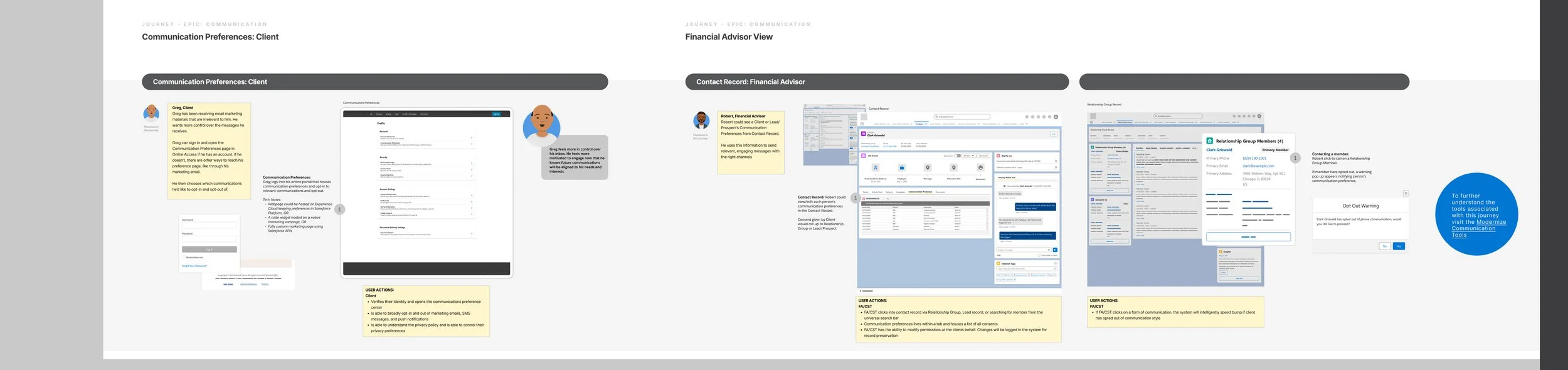
Above you see a sample integrated epic roadmap
What We Delivered:
Our Solutions
We redesigned the advisor platform across six high-value areas that spanned daily workflows, platform structure, and long-term roadmap alignment. Each solution was grounded in our core design principles—Simple, OOTB-First, Scalable, Consistent, and Human-Centered—ensuring that solution strengthened today’s experience while enabling tomorrow’s AI-driven, scalable platform.
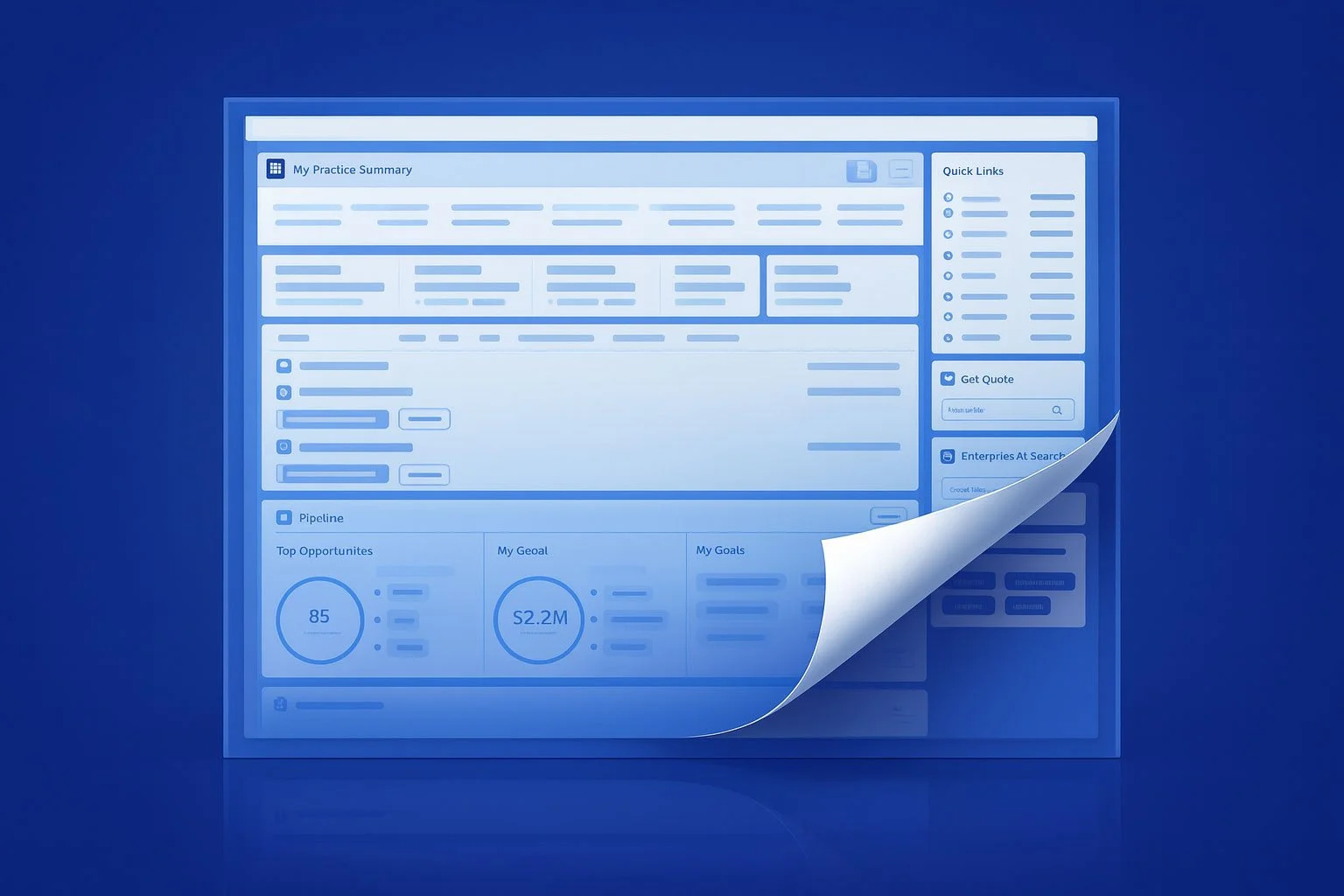
Dynamic, Persona-Aware Homepage
- Redesigned the homepage into a dynamic, role-based workspace that surfaces the most relevant tasks and insights.
- Streamlined daily workflows by reducing navigation overhead and improving clarity.
- Built a scalable foundation for future personalization and AI-driven guidance.
This redesign aligned the homepage to our principles of Simple, Human-Centered, and Scalable, giving advisors a clearer entry point into their daily work. By grounding the experience in native patterns, we also created a flexible surface for intelligent guidance as data maturity grows
Lead & Prospect Management
- Established a true inbound lead funnel
- Enabled multi-channel ingestion and nurturing
- Positioned the org for AI-supported routing and scoring
This was a true greenfield rollout, and the team was prepared to customize from day one. By championing an OOTB-first model, we clarified early-funnel workflows, reduced fragmentation, and created a future-ready lead engine built for intelligent scoring and routing.
Opportunity Management
- Replaced spreadsheets with standardized, OOTB pipelines
- Introduced coaching insights to support advisor development
By replacing ad-hoc tools with standardized pipelines, we established a more consistent and predictable sales process. This foundation improves coaching, forecasting, and decision-making while aligning to sustainable platform patterns.
Client Notes
- Designed an end-to-end workflow for pre-meeting prep, in-meeting capture, and post-meeting follow-up
- Integrated AI summarization and task generation
By streamlining the information architecture and relationship group, we reduced cognitive load and eliminated duplicative inputs—making it easier for advisors to capture meaningful notes. Stronger inputs now power smarter outputs like pre-meeting summaries and task creation, enabling accurate AI-driven insights.
Next-Gen Segmented Marketing
- Created a unified campaign and program workflow using modern segmentation and Distributed Marketing
Our solution connected the home office and branches through shared data, enabling segmented lists and smart action plans. Teams can now target individuals or groups with precision and feed results back to strengthen future campaigns—driving more consistent, OOTB-first, and scalable firm-led initiatives.
Communication & Consent Modernization
- Designed a single, centralized preference center using OOTB data models
- Connected ecosystem tools through well-governed consent
Centralizing consent and preferences reduced compliance risk and strengthened outbound orchestration. This work reinforced Simple, Consistent, and Scalable design—creating a reliable foundation for future communication experiences.
Impact
A Stable, Scalable, and Aligned Platform Built for What’s Next
Platform Stability
We replaced risky customizations with scalable OOTB components, improving performance and maintainability.
Unified Product Vision
For the first time, the organization had a roadmap that connected dozens of initiatives into one cohesive strategy.
Cross-Functional Alignment
We brought business, design, and engineering into a shared decision model—breaking down long-standing silos.
Executive Confidence
The transformation reset program expectations and established design as a core governance function driving long-term success.
AI Readiness
By streamlining architecture and data models, we opened the door to next-generation features across notes, opportunities, and lead routing.
Reflections
My Gold-Standard Example of Enterprise Transformation
This engagement reinforced that experience transformation isn’t about designing screens—it’s about shifting mindsets, clarifying decision-making, and building systems that scale.
Key takeaways:
Governance is the real deliverable. Without it, UX and architecture cannot hold.
OOTB-first is a strategic accelerator. It reduces cost, increases speed, and unlocks AI.
Cross-competency teams outperform silos every time.
Stabilization and vision work best hand-in-hand. Fixing today and planning for tomorrow must coexist.
This work is a gold standard for how I lead enterprise-scale modernization efforts: strategy-driven, human-centered, and grounded in sustainable design.