
Case Study:
A New Era for Connected Customer Support
A global automotive company had spent years trying and failing to modernize the customer and advisor experience behind its connected services platform. Its 20-year-old homegrown CRM had become so brittle that even minor changes required months of development. As instability mounted and workflows diverged across business lines, it became clear that the organization needed more than a redesign; it needed a new foundation.
Over the course of our partnership, we replaced that legacy system with a unified, multi-cloud platform that now powers millions of global customer interactions.
I led the experience and change strategy for this multi-year transformation, partnering closely with business, engineering, and operations leaders to align vision, delivery, and governance. The work demanded clarity, diplomacy, and consistency, and ultimately became one of the strongest examples of “One Team” delivery culture I have been part of.
Overview.
The Challenge.
The company’s legacy CRM and service environment had reached a breaking point:
Fragmented, Outdated Tools
Customer support advisors navigated up to 12 different systems to resolve issues across service lines. Information was inconsistent, difficult to find, and not oriented around the full customer–vehicle relationship.
Limited Data Connectivity
Critical customer, vehicle, and subscription data lived in disconnected systems. Advisors spent unnecessary time searching, cross-referencing, and validating basic information across multiple tools.
Twenty Years of Technical Debt
The homegrown CRM had been extended repeatedly across business units, resulting in brittle integrations, inconsistent logic, and an inability to evolve at the pace the business required.
No Scalable Operating Model
With no unified governance across product, UX, engineering, and operations, teams made decisions independently. This resulted in duplicated functionality, inconsistent experiences, and substantial rework.
Inconsistent Processes
Service lines operated differently across tools, scripts, and processes, even when customer needs overlapped.
No Path to Scale Globally
The company needed to expand into new service lines, digital channels, and regions, yet the legacy system could not support global deployment, multi-language needs, or scalable operations.
The organization needed not just a better tool, but a new foundation: a unified platform, a modern operating model, and a clear strategy for change.
Team Structure.
My Role — Director, Experience Design
I guided the experience and change strategy for this transformation, shaping workflows, information architecture, and multi-cloud patterns into a cohesive platform. I partnered closely with product, engineering, operations, and executive leaders to keep decisions aligned and delivery synchronized across service lines and PIs.
My responsibilities included:
Driving cross-functional alignment through workshops, reviews, and executive presentations
Translating complex service needs into clear workflows and scalable information architecture
Ensuring experience, architecture, and delivery remained connected throughout each PI
Managing experience delivery with our SI partner to maintain consistency and quality across teams
Reducing ambiguity, maintaining direction, and ensuring the platform could scale across regions, channels, and new lines of business
Playing a key role in navigating executive alignment, ensuring competing priorities moved toward a coherent strategic direction.
Team Composition
We built a large, multidisciplinary team to support the scale and complexity of a global service platform.
Experience & Change
10 Experience Designers, including 4 Experience Architects leading major tracks of work and 6 senior designers supporting workflows, IA, and prototyping
2 Human-Centered Change Consultants driving adoption strategy, communications, and training
1 Experience Lead (me) guiding vision, governance, and cross-team alignment
Architecture & Engineering
Solution and technical architects spanning Service Cloud, Automotive Cloud, Data Cloud, Experience Cloud, and OmniStudio
Dedicated engineering teams, MuleSoft developers, and CTI/Voice specialists
Delivery & Governance
A full PMO managing PI planning, release management, integration timelines, and global rollout
Recurring in-person PI planning sessions and co-creation workshops
A unified governance model ensuring product, design, and engineering made decisions together under one shared strategy
Stakeholders & Partners
Product owners and SMEs for each service line (emergency, concierge, billing, subscription care, etc.)
Executive stakeholders across customer experience and engineering
IBM as an SI partner during the initial delivery phase
The Approach.
Process & Strategy: Our approach unfolded in three major phases
Phase 1 — Discovery & Vision (12 Weeks)Assessed the platform end-to-end
We rapidly aligned on the highest-value workflows, prototyped foundational concepts, mapped pain points across lines of business, and defined an actionable backlog for the first PI. By the end of discovery we had:
A prioritized MVP and feature roadmap
High-level IA and vision prototypes
JTBD-aligned customer and advisor needs
Technical feasibility assessments
Pre-build wireframes and flows
A unified view of what “One Platform” could become
Build ready stories for the initial development sprint
Phase 2 — Multi-Cloud MVP Implementation (3 PIs + Hardening)
We implemented a unified multi-cloud platform that replaced the 20-year legacy environment and supported the initial advisor rollout. Our One Team operating model allowed us to deliver:
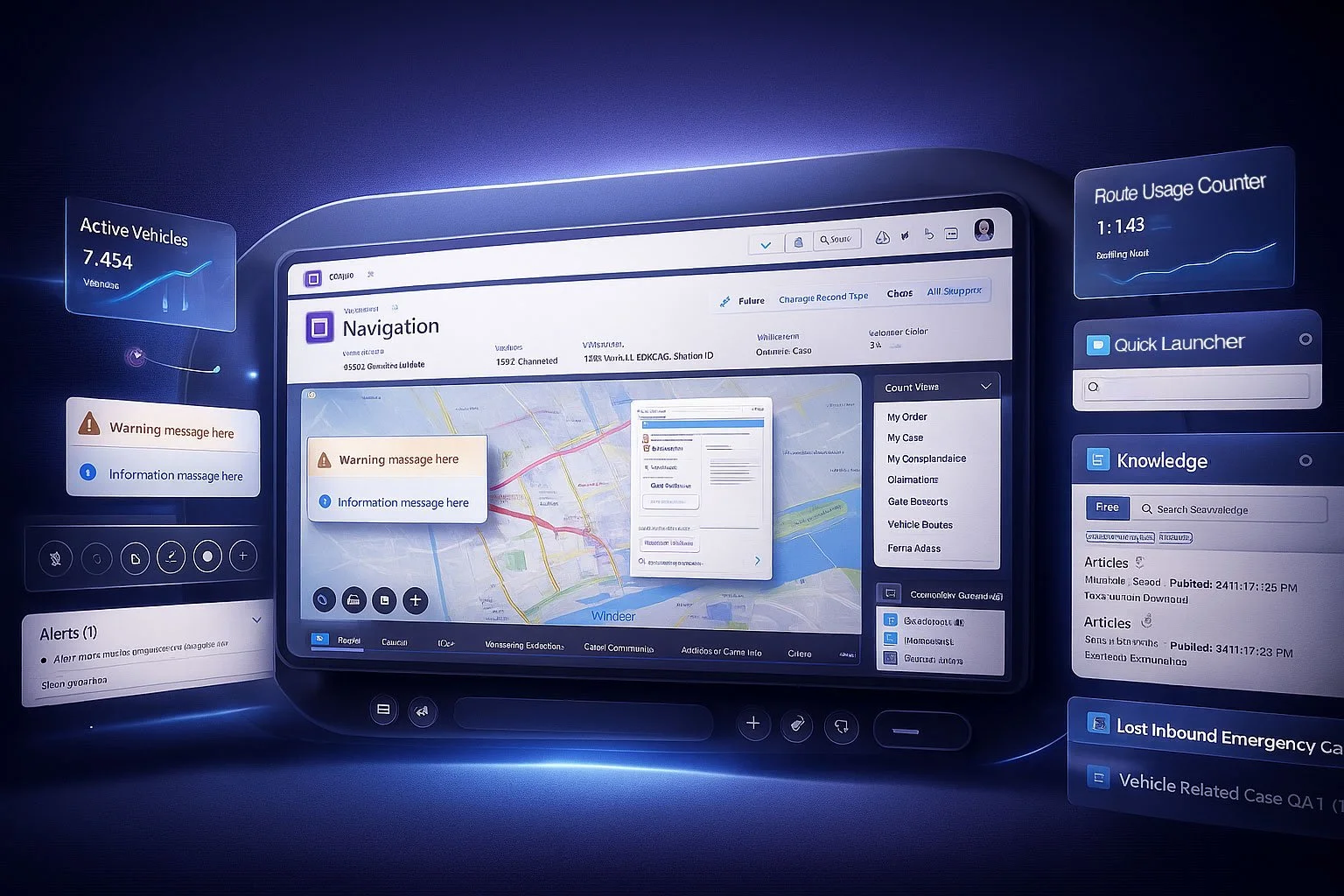
A consolidated advisor console that unified tools and workflows
Connected, guided workflows built with OmniStudio
Multi-language support (EN, FR-CA, ES) across the US and Canada
Integrated CTI with Voice, transcription, and sentiment analysis
Omnichannel routing for calls, chat, messages, and social channels
Scalable integrations connecting customer, vehicle, subscription, and garage data into a single 360° view
An integrated mapping solution for vehicle location, turn-by-turn navigation, and smart location tools
Phase 3 — Ongoing Innovation & Global Expansion
After the MVP launch, we continued to expand functionality, service lines, and regions while strengthening advisor tools and customer experience capabilities.
New knowledge architecture to improve findability and first-call resolution
Subscription care and sales flows supporting new revenue models
A new global self-service portal built on Experience Cloud
A redesigned chatbot to improve deflection and reduce advisor load
Expansion into new regions including Mexico, Europe, and the Middle East
Additional service lines such as critical response, emergency services, and premium concierge offerings
These rhythms created predictable velocity, allowing each PI to build momentum instead of resetting.
By the end of PI 3, thousands of advisors were using a unified platform that allowed us to accelerate major enhancements in phase 3 and beyond…
Field Research.
Understanding Today to Design Tomorrow
We began with a 12-week discovery sprint that included:
26 interviews with stakeholder and advisor
20+ hours of live call shadowing in three call centers
Workshops with supervisors, QA, KM, and training teams
End-to-end experience mapping of key workflows
Full audits of tools, systems, and CTI environments
Co-creation sessions with advisors and supervisors
Early prototypes validation through lightweight testing
Key Insights
The depth of this research gave us a holistic understanding of how advisors think, how advisors work, and what slows them down.
Our research uncovered five truths that shaped the foundation of the work and drove architectural decisions that shaped a more scalable platform:
1. Complexity was slowing both advisors and customers
Workflows felt heavy, repetitive, and fragmented which was adding time to every interaction.
2. The legacy CRM hid critical context.
Advisors couldn’t see a full picture of the customer, their vehicle, or their subscription history without navigating multiple tools.
3. Information architecture, not effort, was the barrier.
Knowledge articles, scripts, and disclosures existed, but were buried or inconsistently maintained.
4. Customer expectations have changed.
Advisors were caught between legacy tools and modern customer expectations across mobile apps, emergency lines, and concierge services.
5. The organization needed a scalable operating model.
Decision-making, governance, and cross-team collaboration needed to evolve to match the scale of the transformation ahead.
Quotes.
“I feel like I work for the tool, the tool doesn’t work for me”
— Client Advisor
“I come in 2 hours early on my own time every day. I don’t mind doing it though, it’s important to my team and I want to see them succeed”
— Supervising Team Lead
These conversations brought the company’s challenges into sharp focus and clarified where designing for simplicity, clarity, and trust would have the greatest impact.
Driving Principles.
We established a shared set of principles, rooted in our research and aligned across product, operations, engineering, and design:
Know Me — Use data to provide personalized, contextual experience. Avoid repetitive information gathering.
Empower Me — Support both self-service and advisor-led interactions with clear next steps and natural escalation paths.
Value My Time — Reduce steps, increase automation, and remove unnecessary friction.
Earn My Trust — Provide accurate, transparent information and set expectations clearly.
Bring Me Joy — Design interactions that are empathetic, intuitive, and easy to navigate.
These principles became the backbone of every design, architectural decision, and change-management plan across the program.
A Unified Platform Replacing a 20-Year Legacy System
We built a multi-cloud ecosystem that connected customer identity, vehicle data, subscription history, emergency services, and concierge workflows into a single, trusted console.
Cross-Competency Governance & Operating Model
We established a long-term operating model that united design, product, engineering, and operations—ensuring decisions remained consistent, scalable, and rooted in our design principles.
Cross-Competency Governance & COE Model
We delivered a model that could extend to new countries and lines of business without rework—ultimately supporting North America, Mexico, Europe, and the Middle East.
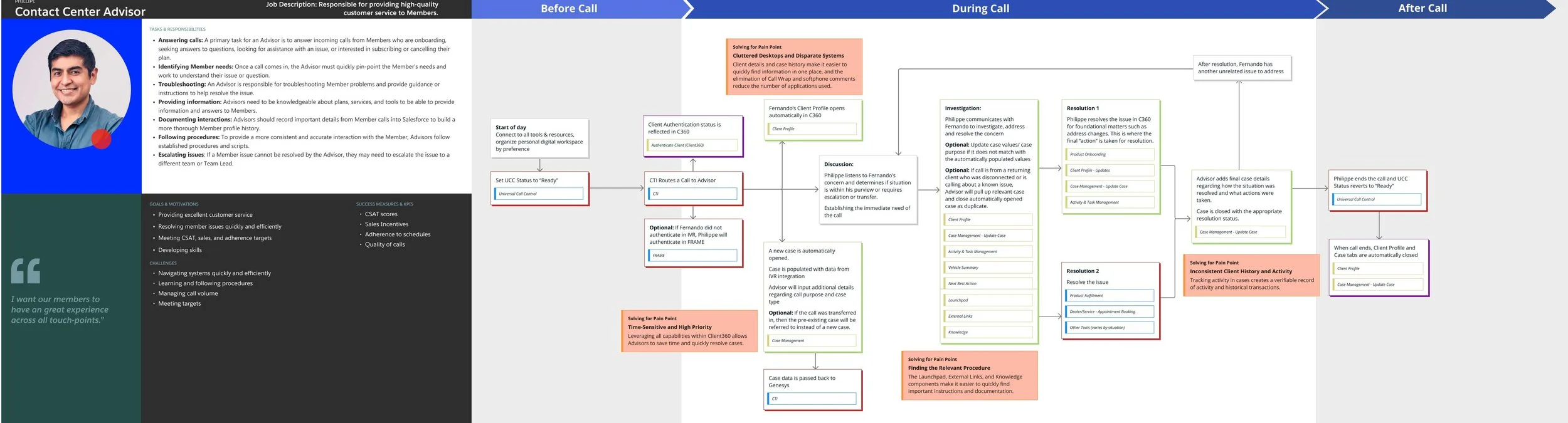
Above you see a sample experience journey map
What We Delivered
The Platform Foundation
Before expanding service lines or regions, we first had to create a stable, unified foundation the organization could build on. These core platform elements enabled every major improvement that followed.
What We Delivered:
Key Advisor Moments
We designed and implemented a connected service platform that unified customer, vehicle, and advisor experiences. These six solution areas formed the core of the transformation and aligned the organization’s service model with our principles of Empower Me, Know Me, Value My Time, Earn My Trust, and Bring Me Joy.
Customer 360
- Consolidated 12+ legacy tools into one advisor console
- Unified customer identity, subscription history, and interaction data
- Surfaced key context automatically to reduce search and manual lookup
- Standardized navigation and workflows across all service lines
This console dramatically reduced cognitive load by giving advisors a single, contextual place to work. It reinforced our principles of Empower Me and Value My Time by eliminating redundant steps and ensuring advisors saw the right information at the right moment.
Vehicle 360
- Connected vehicle records with real-time status, VIN data, and diagnostics
- Integrated subscription status, warranty coverage, and service history
- Linked garage information for service scheduling and shop coordination
- Standardized data structures shared across all lines of business
Vehicle 360 created a holistic, instantly understandable view of the vehicle and its available services. Advisors could see service history, take action effortlessly, identify upsell opportunities, and track location on the map, strengthening Know Me and Earn My Trust through accurate, transparent, and connected data.
Advisor Homepage
- Designed a personalized homepage with smart statistics and performance insights
- Created role-based views for advisors, supervisors, and specialists
The new homepage consolidated multiple tools and logins into a single, clear starting point. Advisors could follow up on recent and open cases instantly, and supervisors or higher-tier teams saw the information most relevant to their roles. This ensured everyone began their day empowered and confident, aligning to Empower Me and Value My Time by reducing uncertainty and guiding users to the actions that mattered most.
Connected Service Workflows
- Designed guided flows for emergency triage, subscription care, concierge services, and technical support
- Standardized disclosures, scripts, and steps across service lines
- Improved accuracy and speed for both routine and high-stakes interactions
These connected workflows delivered a more intuitive path through complex service scenarios. They represented Bring Me Joy and Value My Time in action, helping advisors resolve issues faster and with greater confidence.
Map & Location Services
- Embedded integrated mapping into the broader advisor console
- Provided real-time vehicle location and smart search for nearby services
- Supported advisor workflows for unlocks, diagnostics, and routing
Location-aware interactions became dramatically easier. This strengthened Value My Time, Bring Me Joy and Know Me by eliminating manual lookup and surfacing actionable spatial context exactly when needed. The integrated map and Vehicle 360 also enabled smart recommendations, such as recent trip information, creating moments of clarity that surprised and delighted both advisors and customers.
Omnichannel Engagement
- Implemented CTI with Salesforce Voice providing real-time transcription
- Enabled sentiment scoring and automated wrap-up
- Connected chat, messaging, and social channels into one unified console
- Created a scalable foundation for future conversational AI
By unifying channels and enhancing them with real-time intelligence, advisors could respond faster and with greater accuracy. Real-time transcription became a game changer, helping advisors understand customers clearly, complete requests without repetition, and close out interactions more confidently. This reinforced Earn My Trust and Empower Me by making every interaction clearer, more cohesive, and more human.
Impact
A platform and operating model that changed how the organization serves customers
A Platform Reaching Thousands
The first release moved 2,500+ omnichannel advisors in the US and Canada onto a unified platform, replacing a 20-year legacy system and enabling hundreds more to onboard quickly.
Unified Multi-Cloud Ecosystem
We replaced a decades-old CRM with a connected platform spanning Service, Automotive, Data, Experience, and MuleSoft, eliminating redundancy and creating a flexible foundation for future evolution.
A True “One Team” Culture
Salesforce, client teams, and SI partners operated as a single team with shared rituals and transparent decision-making, strengthening executive trust and stabilizing delivery.
Faster, More Accurate Service
Improved IA, connected workflows, and a modern knowledge layer reduced handle time and boosted first-call resolution, giving advisors clearer context and more confidence.
A Scalable Global Framework
An OOTB-first foundation made global expansion possible, including Mexico, Europe, and the Middle East, showing that great experiences scale across borders.
A Strong, Shared Operating Model
A unified governance model aligned design, product, engineering, and operations, bringing clearer decisions, more predictable PIs, and smoother cross-functional delivery.
Reflections
A Case Study in Large-Scale Transformation and One Team Culture
This engagement reinforced that enterprise transformation requires more than new tools—it demands vision, structure, and a unified operating model. It required balancing strategic thinking with hands-on delivery, managing intense executive expectations, and building trust with teams who had been burned by past initiatives.
Key lessons:
Scale requires clarity. A simple, unified direction helped reduce friction and kept a large, multi-cloud program moving forward.
Experience must stay at the center. Keeping the advisor experience in focus grounded every workflow, IA decision, and design choice.
Partnership matters. Deep alignment between Salesforce, client teams, and SI partners created a true “One Team” delivery culture.
Human connection still counts. In-person PI planning, workshops, and co-creation accelerated alignment and built trust, even in a remote-first model.
Shared principles keep complexity manageable. Strong experience, design, and governance guardrails kept teams coordinated
This was the kind of project that changes how organizations work—and it remains one of the strongest examples of experience-led transformation I’ve delivered. The work reinforces my belief that large-scale transformation requires equal parts clarity, collaboration, and conviction — and that culture is as critical as the platform itself.